
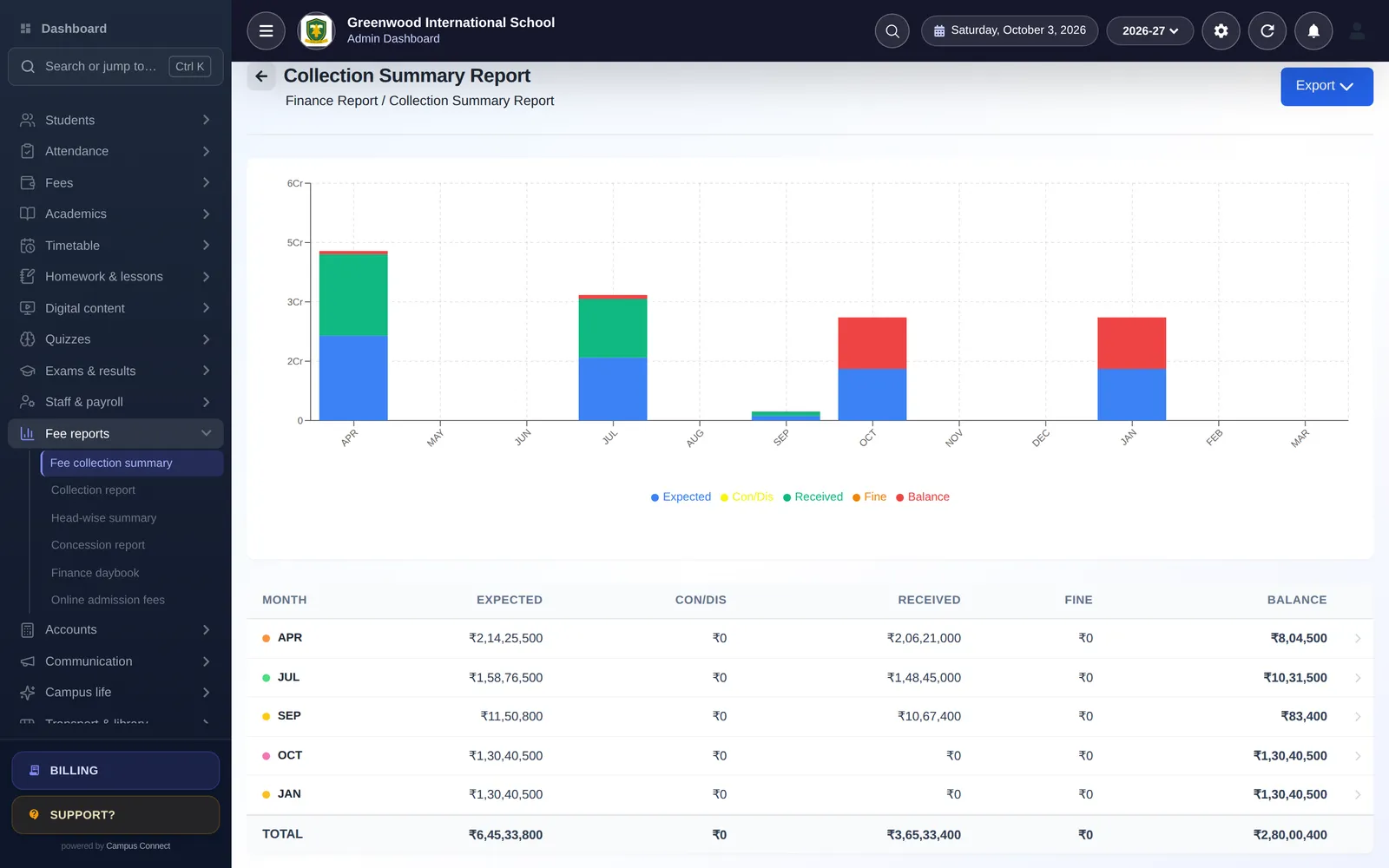
Fee collection is the heartbeat of a private school’s finances. When it runs smoothly, salaries are paid on time, the school can plan improvements, and the accounts office has time for more than chasing payments. When it doesn’t, everyone feels it — including parents, who rarely enjoy reminder calls any more than the staff making them.
This article sets out practices that work well in Indian schools of every size, whether you collect at a counter, online, or both.
Start with a fee structure parents can understand
Most fee disputes start with confusion rather than unwillingness to pay. A clear structure prevents a large share of follow-up work.
- Use a small number of fee heads with plain names. “Tuition fee”, “Transport fee”, “Annual charges” and “Exam fee” are easy to understand. Ten heads with overlapping names are not.
- Publish the full year’s structure at admission time. Parents plan their household budgets; surprises mid-year damage trust.
- Be explicit about installments. If tuition is payable quarterly, list each installment, its amount and its due date.
- Write down your policy on late fees, concessions and sibling discounts — and apply it consistently.
Keep a single source of truth for the structure. If the accounts office, the front desk and the parent handbook each show slightly different numbers, parents will notice.
Make due dates predictable
Predictability matters more than the exact date you choose. Pick due dates that fit your community — many schools align them with the first week of the month, after salaries are credited — and keep them the same every year.
Send a reminder a few days before each due date, not only after it has passed. A friendly “the second-quarter tuition fee is due on 10 July” message gets a much better response than an overdue notice.
Offer convenient ways to pay
Parents’ preferences vary. Some want to pay online in the evening; some prefer cash or cheque at the counter; some pay through a bank transfer from their office. Offering several channels reduces delays:
- Online payment in the parent app — the parent sees exactly what is due and pays in a few taps.
- Counter collection with a printed or digital receipt.
- Clear bank details for transfers, with instructions on what reference to include.
Online payment does more than save a trip to school. Because the payment is recorded against the right student and fee heads automatically, the accounts team spends far less time matching bank entries to students.
Issue receipts immediately — every time
A receipt is a parent’s proof of payment and the school’s proof of what was collected. Best practice is simple:
- Every payment gets a receipt with a unique number, the date, the student, the heads paid and the amount.
- Online payments generate the receipt automatically, so parents never wait.
- Receipts are never edited after the fact. If something was wrong, the receipt is reverted with a reason, and a correct one is issued — so the audit trail stays intact.
Reconcile daily, not monthly
Daily reconciliation sounds like extra work but saves time overall. At the end of each day, compare:
- Cash collected with the cash receipts in the daybook.
- Cheques received with the cheque register.
- Online payments recorded with the payment gateway’s settlement report.
Small differences found the same day are easy to explain. Differences found at month-end take hours to trace.
Follow up on dues calmly and consistently
Even with a clear structure and easy payment, some fees will be late. A consistent, respectful process works best:
- A reminder before the due date (SMS, push notification or email).
- A reminder a few days after the due date, still friendly.
- A personal call from the accounts office for longer delays — often there’s a reason, such as a job change or medical expense, that the school can help with through an installment plan.
- A meeting with the principal only after these steps.
Avoid singling out children for parents’ delays. It’s unfair on the child, and it rarely speeds up payment.
Use reports to see problems early
A good due report shows, at a glance, which classes have the most pending fees, which families have dues from earlier sessions, and how collection this month compares with the plan. Review it weekly with the principal. Patterns — one class with unusually high dues, for example — often point to a communication problem rather than a payment problem.
Connect fees to your accounts
When fee collection lives in one system and accounts in another, the accountant ends up re-entering totals and reconciling two sets of numbers. If fee receipts post automatically to your ledger, the daybook, trial balance and profit and loss statement are always up to date — and audits become much less stressful.
A short checklist
- Fee structure published at admission, with plain-named heads and installments.
- Predictable due dates and reminders before each one.
- Online, counter and bank-transfer options.
- Instant receipts; corrections by reversal, never by editing.
- Daily reconciliation of cash, cheques and online payments.
- A calm, consistent follow-up process for dues.
- Weekly review of the due report.
How CampusConnect helps
CampusConnect brings these practices together: fee heads, class-wise structures, installments and fines; online payment from the parent app with instant receipts; due reminders by SMS, email and push notification; reversible receipts with an audit trail; and fee collections that post automatically to a double-entry ledger with daybook, trial balance, P&L and balance sheet.
If you’d like to see how it would work with your school’s fee structure, book a free demo — we’ll set it up with your own fee heads.