
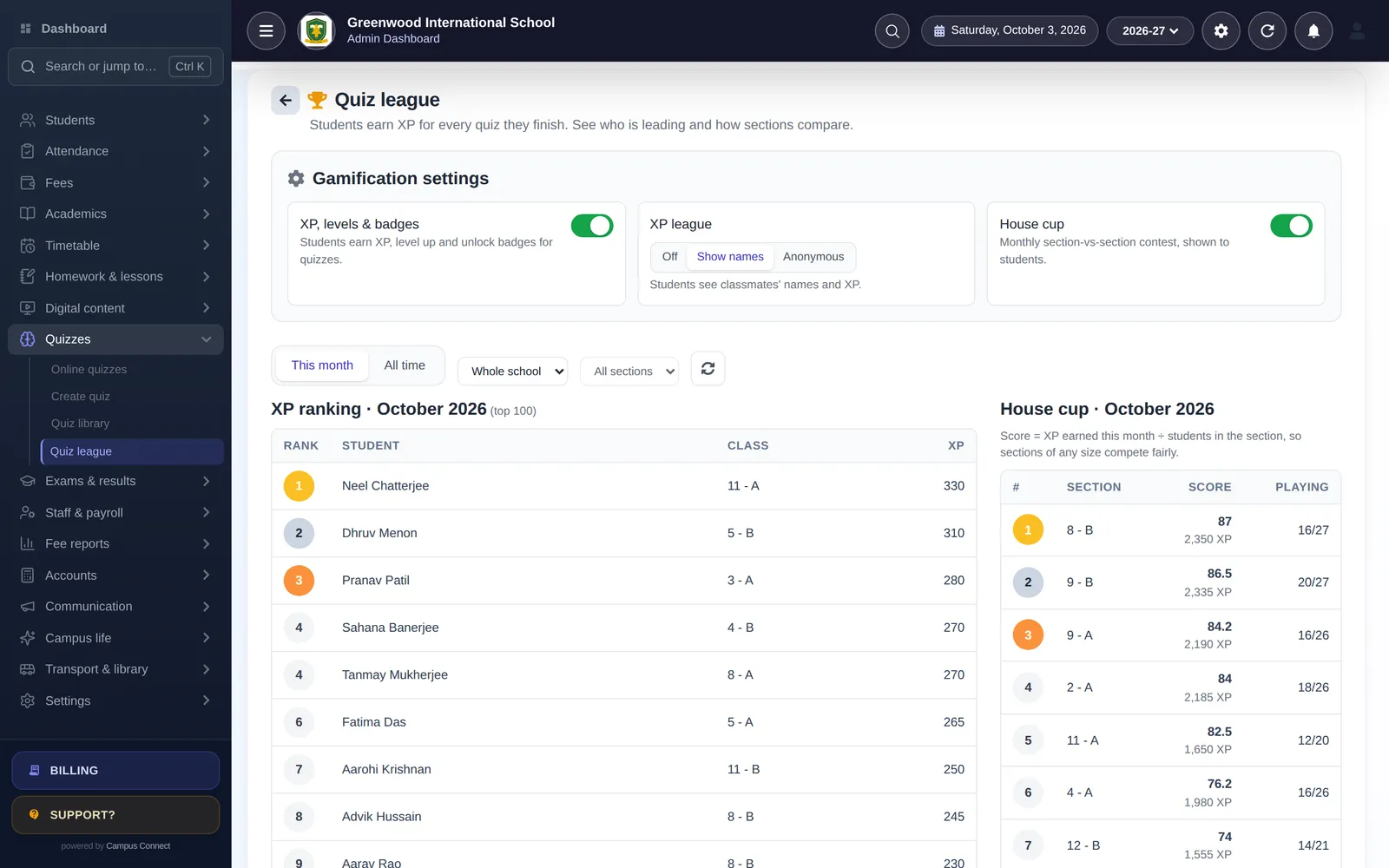
Gamification means using elements of games — points, levels, badges, streaks, leaderboards — in a non-game setting like learning. Many students who would never volunteer for extra practice will happily do “one more quiz” to reach the next level. But gamification can also backfire: it can make some students anxious, reward speed over understanding, or turn learning into a contest that only a few can win.
This article looks at what tends to work in schools and how to avoid the common pitfalls.
Why gamification can help
- Small, visible progress. Levels and points make progress concrete. Students see that effort adds up.
- Habits. Streaks encourage a little practice every day, which is better for memory than occasional cramming.
- Recognition. Badges celebrate milestones — a first quiz, a perfect score, a long streak.
- Belonging. Team competitions, such as house or section contests, give students a shared goal.
The elements, and how to use them well
Points (XP). Award points for completing practice, not only for high scores. Bonus points for getting several answers right in a row or finishing promptly can add excitement, but the base reward should be for doing the practice at all.
Levels. Levels translate points into a sense of progress. Make early levels quick to reach so every student experiences success.
Badges. Use badges for milestones anyone can reach with effort — first quiz finished, ten quizzes completed, a week-long streak — alongside a few for excellence.
Streaks. Daily and weekly streaks encourage routine. Be gentle: missing a day shouldn’t feel like a disaster, especially for students without reliable device access.
Leaderboards. These are the most powerful and the most risky. Consider:
- Showing a league only within a class, not the whole school.
- Making it anonymous, so students see their position without exposing others.
- Turning it off for younger classes or if it causes stress.
Team competitions. A house or section cup shifts the focus from individuals to groups. Score teams fairly — for example, by average points per student, so small sections aren’t disadvantaged by size.
Common pitfalls
- Rewarding speed over understanding. If points depend mostly on speed, students rush. Keep speed as a small bonus.
- Public shaming. Leaderboards that highlight the bottom of the class discourage the students who most need encouragement.
- Extrinsic-only motivation. If points become the only reason to learn, interest can fade when the points stop. Pair rewards with genuine feedback and explanations.
- Inequity. Students with less access to devices at home can fall behind on streaks and leagues. Offer practice time in school.
- Over-complication. Too many rules and currencies confuse students. Keep the system simple.
Practical tips for teachers
- Introduce the system to the class and explain that it’s about practice and improvement.
- Mention personal milestones — “five students reached Level 3 this week” — rather than only the top scorers.
- Use the House or section cup for friendly competition in assemblies.
- Check participation data: who isn’t practising, and why?
- Ask students what they enjoy and adjust.
Let schools decide
Every school community is different. The most important feature of a gamification system is control: the ability for the school to switch elements on or off, choose between named and anonymous leagues, and decide what’s shown to whom.
A worked example: introducing gamification to Class 5
Imagine a Class 5 teacher who wants more students to practise Maths between lessons. A gentle introduction might look like this:
- Week 1: Explain XP and levels to the class. Assign one short quiz on the topic just taught. Everyone who finishes earns XP, regardless of score, and most students reach the first level quickly.
- Week 2: Introduce streaks. Assign a short quiz every other day. Mention in class how many students kept a streak going — without naming anyone who didn’t.
- Week 3: Turn on a section-level House Cup for the month, scored on XP per student. The class now practises for its section, not just for itself.
- Week 4: Review participation. Who hasn’t practised at all? A quiet word, or practice time in the computer lab, often helps more than any reward.
Throughout, the teacher uses the questions most students got wrong to plan the next lesson. The game elements bring students to the practice; the teaching follows the results.
Questions teachers often ask
Should we show names on the leaderboard? It depends on the class. Older students often enjoy a named league; for younger classes, or if some students are anxious, an anonymous league or the section-level House Cup works better.
Won’t students just rush to earn points? Keep the base reward for completing practice and make speed a small bonus. Explanations after wrong answers help students slow down and learn.
What about students without a device at home? Offer practice time in school, and make sure rewards are spread across the term so they can catch up.
Key takeaways
- Reward completing practice, not just top scores.
- Prefer section-level or anonymous competition for younger classes.
- Let the school switch elements on and off.
How CampusConnect helps
In CampusConnect, every quiz earns XP — for the score, stars, correct answers in a row, speed and the first quiz of the day. Students level up, unlock badges and keep daily and weekly streaks. The class and school XP league can show names, be anonymous, or be switched off, and the House Cup compares sections on XP per student so small and big sections have a fair chance. Admins control every setting from the Quiz league screen.
Book a free demo to see how gamification works with your classes.